The sea is iron-gray and cold, the kind that seeps through the wetsuit and into the bones. The Farallon Islands rise like broken teeth from the water—sharp, silent, and full of memory.
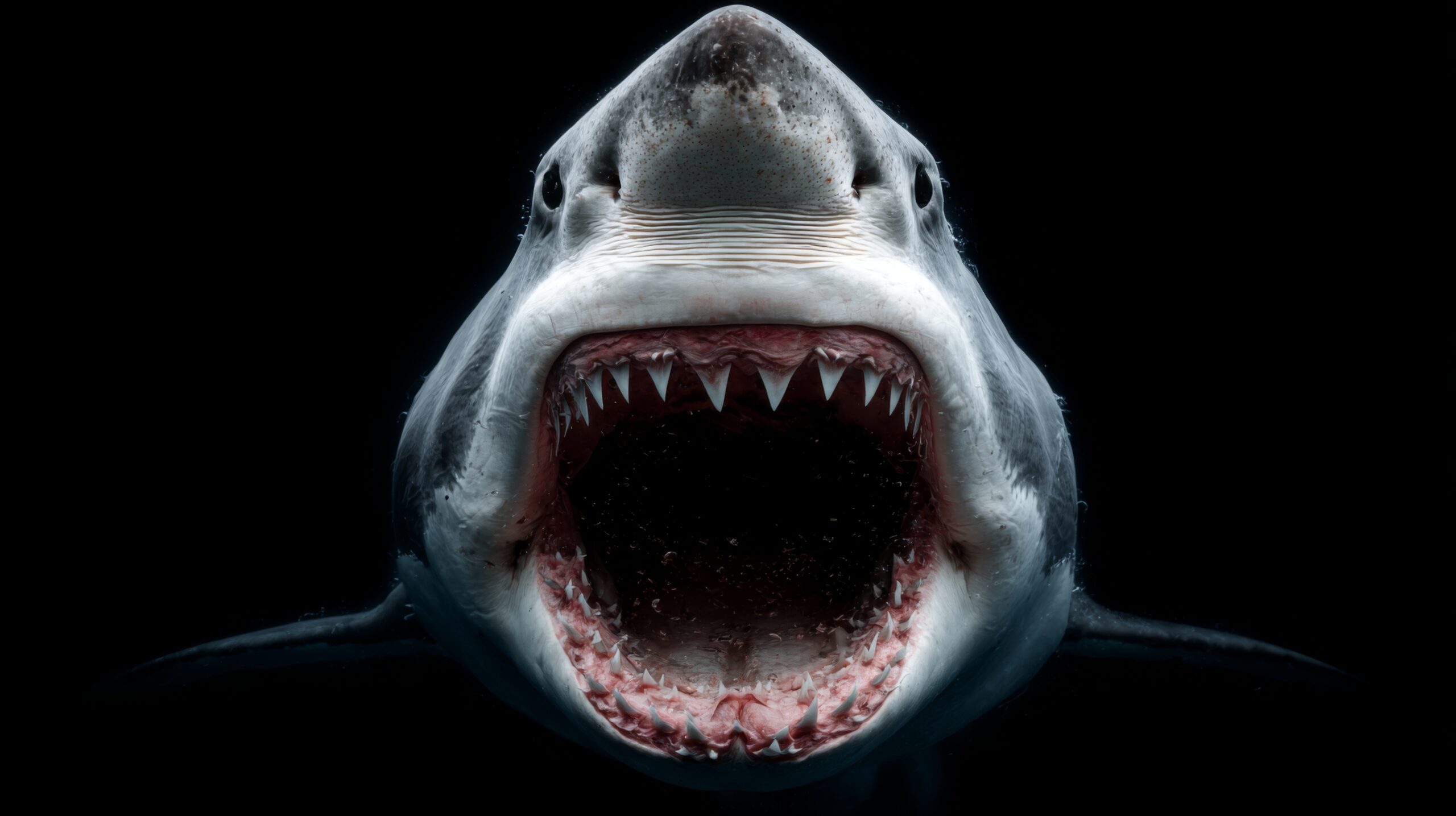
You can stand at the stern of the boat and look down into the dark. The deck smells of salt, rust, and fear. Below you movement—shadow upon shadow. You know they’re there. Ancient beasts. Heavy, patient, without anger or hurry. The alarm bunker in your brain senses they are circling boat in wide, deliberate arcs, their bodies moving with the same easy grace as smoke. Their eyes black, unblinking things that do not care what you are and why you’ve come. They are older than reason and pure in their simplicity: hunger, motion, survival.
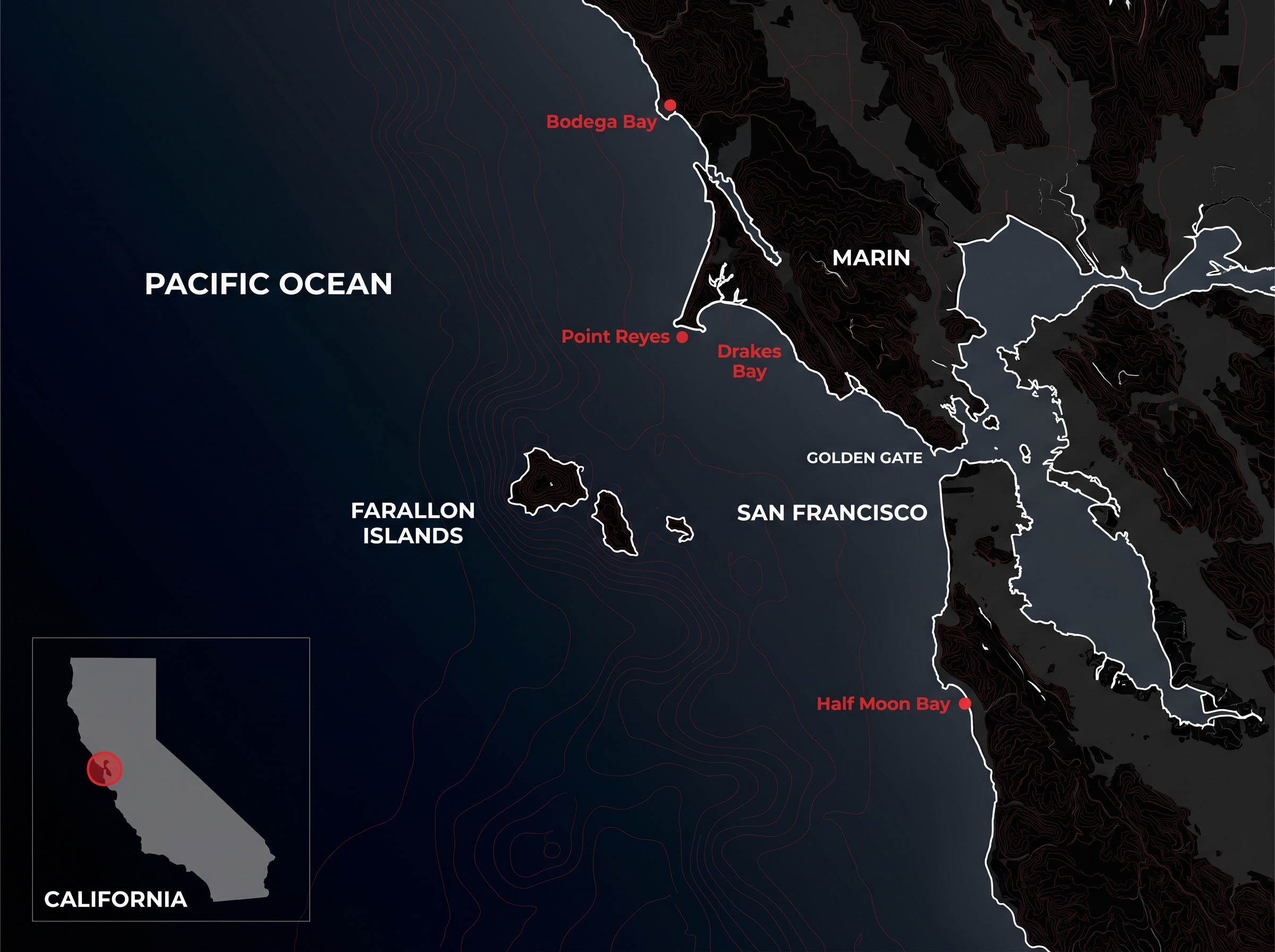
You are 25 nautical miles due west from San Francisco, swashing in unforgiving blackwater, about to climb into a sketchy wire cage and dance with the alpha ruler of the open sea, Carcharodon carcharias, the Great White Shark.
You’ve always fantasized about this moment, and now its here. You and two other souls enter the cage. The cage floats at the surface, so when you stand on its floor your head sits only a foot or two under the water, more like vertical snorkeling than deep diving. You wear a thick wetsuit, hood, boots, gloves, and a weight belt so you can plant yourself on the cage bottom while air comes through a hookah-style hose from tanks on the boat. Water temps hover in the low‑ to mid‑50s Fahrenheit during shark season, which feels brutally cold on exposed skin but manageable inside good neoprene. The Pacific heaves and groans around you. Operators keep a dive pro right by the cage, lines securing it to the boat, and redundant floatation so even a worst‑case gear issue leaves the cage bobbing at the surface. In the cage you feel the surge and roll of the swell, hear the thud of waves against steel and the hiss of your own breathing, and watch gulls and murres wheeling on the surface above you. It’s surreal.
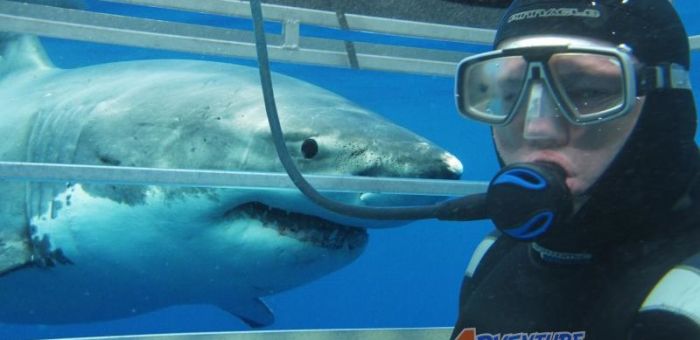
Understandably, you begin to ask yourself why you are doing this? There is real risk on paper, and you sign waivers acknowledging injury or death is possible, but these trips report a perfect safety record; the sharks are there for elephant seals, not humans behind bars.
There is a deep-rooted human element to all of it. Getting close to sharks mixes fear, awe, and meaning: it lights up the body with adrenaline, but also rewires how we think about danger, wildness, and our place in the food chain. Sharks plug directly into an old, story‑fed terror of being hunted, so sharing water with them lets people confront a nightmare in real life and walk away empowered instead of helpless.
Shark encounters like this trigger a classic fight‑or‑flight surge—heart rate spikes, blood shifts to big muscles, senses sharpen—yet the controlled setting lets that fear feel exhilarating instead of purely threatening. Many divers report that once the initial jolt settles, being in the water with sharks feels strangely calm or meditative, even slightly hallucinatory—as if fear has flipped into focused presence. If you’re a high “sensation seeker,” that intense but survivable edge state becomes addictive, the same neural circuitry that processes fear overlapping with circuits for motivation, pleasure, and even love.
Moreover, seeing sharks as individuals instead of movie monsters often flips people from fear to fascination, increasing empathy and a sense of shared ocean “belonging.”
When sharks do appear, they materialize as thick gray ghosts first—a shadow, a tail, then the bulk and black eye sliding past the bars, sometimes circling toward the seal‑decoy just beyond you. One passes close enough that you can see the scars along its flank—white lines cut by other teeth, other battles. The tail flicks once, slow and powerful, and the water trembles. Another comes from beneath, rising from the murk like an old god returning to reclaim what was his. In that moment, you understand how small you are and how little the sea cares for your understanding. And still, you feel something like gratitude, standing in the cage with hands numb on the bars, watching these perfect and merciless creatures move through the cold dark of their home.
The boat usually spends most of the day on station at the Farallons, often 6–8 hours at the islands depending on conditions and shark activity. Underwater sessions are broken into rotating cage shifts that typically last around 20–30 minutes per diver at a time, repeated several times over the hours the cage is in the water.
Prime dates cluster on select weekends from late September through mid‑November, with current pricing around $900 for cage divers and $500 for topside observers on one-day trips.
Farallon Islands trip details and dates: incredible-adventures.com/sharks-farallons-1day.html
California cage diving overview: cagediver.com/california-cage-diving.html
For Farallon Islands shark cage trips run via Incredible Adventures / Shark Dive Adventures, use:
Main phone (toll‑free, US/Canada/Mexico): 800‑644‑7382
Email: info@cagediver.com and info@sharkdiveadventures.com
Choose the most boring, safety‑obsessed operator you can find
Look for strict sanctuary permits, conservative weather cutoffs, no baiting or sketchy chumming, and a long, uneventful incident record; adrenaline should come from sharks, not from the boat.
Enter and exit the cage like glass, not a YouTube fail
Use slow, three‑point contact on the ladder and let crew pass cameras and gear in and out; most injuries happen when people rush transitions and smash fingers, masks, or ribs.
Keep every limb and gadget inside the bars
Treat the cage as a hard boundary: no hands, fins, or cameras poking through the gaps, and keep a firm grip when sharks get close so swell or bumps don’t slam you into the steel.
Manage hoses, buddies, and your panic response
Keep air lines and straps tidy and away from the bars, stay aware of where your cage‑mate is, and focus on slow breathing and fixed points instead of flailing at the surface when a shark appears.
Know what to do if something actually goes sideways
Ask about emergency hatches and procedures before you ever get in; if crew call for an exit due to gear or sea‑state issues, move fast but controlled back to the boat, inflating as briefed and avoiding long, panicked waits at the surface
Location: Greater Farallones National Marine Sanctuary, about 25–30 nautical miles off San Francisco, California, USA
Season: Prime great white season typically runs from mid‑September to late November, with one‑day trips concentrated on select weekend dates.
Price: Around 900–925 USD for cage divers and about 500–525 USD for topside observers on one‑day trips, including gear and meals on board.
Operator Basics: Trips run on research‑style vessels (around 60–70 ft) with floating cages, surface‑supplied air, and 12 cage divers plus additional topside observers on board.
Good to Know: No dive certification required; water is cold and often murky, sea conditions can be rough, and departures are weather‑dependent—flexible dates, heavy layers, and seasickness meds are not optional.
By TH